

How to Résumé
Putting your playwriting journey down on paper

Nothing empties my brain and fills me with dread faster than somebody hitting me with that diabolical “So tell me about yourself.”

I think that’s why I love having a piece of paper or PDF that has all my facts and history already written down on it. I can easily hand that over like… “any further questions?” It saves one from having to hear about my childhood love for Goosebumps when they really just wanted to know how I got into professional theatre.
With artist statements, that’s a whole different struggle, but one thing at a time. Today, I am grateful for ✨the resume✨. And seeing how we’re in the middle of a big submission season, I’d love to offer some resume crafting basics with a few personal opinions mixed in. As always, take what’s useful, leave what’s not. We’re just adding to the toolkit.
The Basics
First of all, a playwriting resume isn’t your traditional job resume. No food service, no Microsoft Excel proficiency (although, that’s useful tool for a playwright). No, your playwriting resume is closer to a creative portfolio in list form, specifically tailored to highlight your written work and experiences as a writer. It gives a clear, easily digestible snapshot of your career thus far, while showcasing your achievements as a playwright.
It’s purpose here is less “give me an interview and hire me, please” and more “this is who I am, here’s what I’ve accomplished, here’s how to find out more, and here’s how to get in touch.”
A resume doesn’t get you a production or guarantee you a new client, but it introduces you and your work to someone new, and opens the door to start building a relationship. Which, in this business…is King.
Let’s break down the resume into its various parts:
Start with a HEADER.
Set it somewhere near the top of the page. I like mine centered, but that’s not a rule. Include your name and contact info, at least email and phone number.
Incoming Opinion: I don’t list my physical address. I’m not doxing myself to just anybody. And it’s usually on the title page of my script (unless you download from NPX). If someone really needs it, they can reach out.
Website/Profiles/Social Media
Be sure to include your website, New Play Exchange profile, and possibly a social media account if it feels right. I list my TikTok because I make theatre and playwriting content. As long as it’s relevant and connected to your work, you could list it.
Pro Tip: Hyperlink as much as possible to save space and present a cleaner, less cluttered look.
Common Nouns
Another Opinion: Include common nouns. I’m a playwright, but I also have screenwriting credits and want to position myself as a screenwriter, so I’m going to include that here in my header. This is partly a branding thing, but it also sends a clear message to folks engaging with your resume: this is who I am and this is what I do.
Here’s what the header of my resume looks like (minus my phone #):

Once you’ve got that, you’re ready to move on to the BODY.
There’s lots of ways to do a layout for the body. But typically you’ll use Bolded section headings in some sort of row or column format for your listings. Check out the templates at the end of this post to see examples.
But as far as content, sections you’ll want to include are:
Plays
You spent all this time writing, you better list them plays! List productions, workshops, and readings. List the producing or developing theatre company and the year.
Opinion: I like to list directors. The theatre world is small. Someone seeing a familiar name may give me another point of connection. But this does take up space on the page. Pros and cons.
If you’ve got both full-length and short plays, break them into different categories. Create a third category for your screenwriting, if you have credits (include web series & short film). Include screenplay title, episode title (if series), format (web series, feature film, etc.), production company (write “Unproduced” if that’s the case), and year.
Pro Tip: Early career playwrights: List all your plays. Even if they haven’t had any productions, workshops, or readings.
Accolades
We gotta get our pats on the back anyway we can. List your honors, awards, and fellowships (winner, finalist, semifinalist statuses welcome). If you have nabbed any grants, commissions, or residencies you can create categories for those. Include the name of the award, the organization, and the year it was awarded.
As a general rule, when listing a credit, include the year.
Affiliations/Writers Groups
Are you a member of an organization like the Dramatists Guild of America or writers group? List it.
Teaching
List all your teaching experience. Have you done any speaking at colleges or events, list those invited presentations.
Publications
This is for fully published plays, excerpts or monologues, essays. If it’s published in print or online, list it. Include the title, the format (essay, short play, etc.), the publication or platform, and, of course, the year.
Education
Got debt—I mean a theatre degree? Taken a workshop? List it here. Include institution/organization name, degree/course, and one or two instructor names.
Opinion: This is the one place you don’t want to put a date. The year you graduated is between you and Jesus.
And that’s it! You’ve got a resume!
More Thoughts
Fonts
Choose a font that is easy to read.
Length
For more established writers, I say two pages is fine. If it starts grow beyond that, you may be looking at a CV and might consider culling it a bit.
Condensing Tips
Consider keeping what is most recent or more high profile, and trimming the older, less impressive credits. For instance, you might delete the 10-minute play you produced in college, trading an academic credit for a professional one. Another thing you might do is create two different resumes. A 1-2 page curated resume with most of your professional and highest profile credits, and a full resume with your entire professional catalog and accomplishments. You can have either at the ready should you need them.
What to Do If You Don’t Have Many Credits
If you have the opposite problem and have fewer credits, then first, as I said in the Plays section, list em all, whether they’ve been produced or not. List them, name that they’re unproduced, and include the year they were written. Second, think creatively about what you do have. List volunteer experience, apprenticeships, dramaturg work. If it’s reasonably in the land of writing or new play development, list it. This is a hard business. People will understand and won’t penalize you for having few credits.
Chill
Remember, the resume is just introducing folks to you and your work. You don’t have to list everything that has ever happened in your career. You can create a CV for that. And the gift of having a website is you can always list your work and achievements there in greater detail than could ever fit in a couple of pages.
Resources
Editable Template
Here’s an editable template I’ve created in Microsoft Word (.docx format). Please feel free to download and use how you see it.
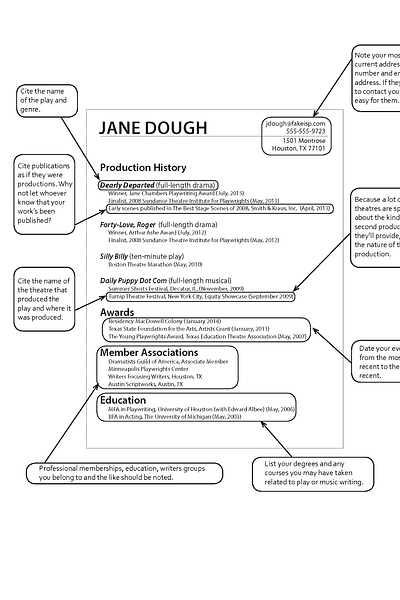
Dramatists Guild Template
Take a look at this resume template created by the Dramatists Guild of America. It’s a little out of date, but still has some good information, and can give you another idea for a possible layout design.
Lastly…
Why, yes, you’re right it is submission season!
And now that you’ve got a resume, you need some places to submit it to. Check out the submission listings below (regularly updated).
Happy resume crafting, dear writer!
Is it worth still putting a resume together if it is very minimal?
Thank you for the info!